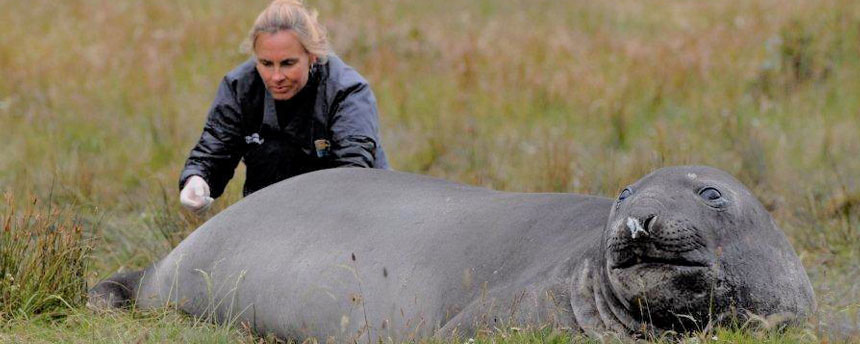
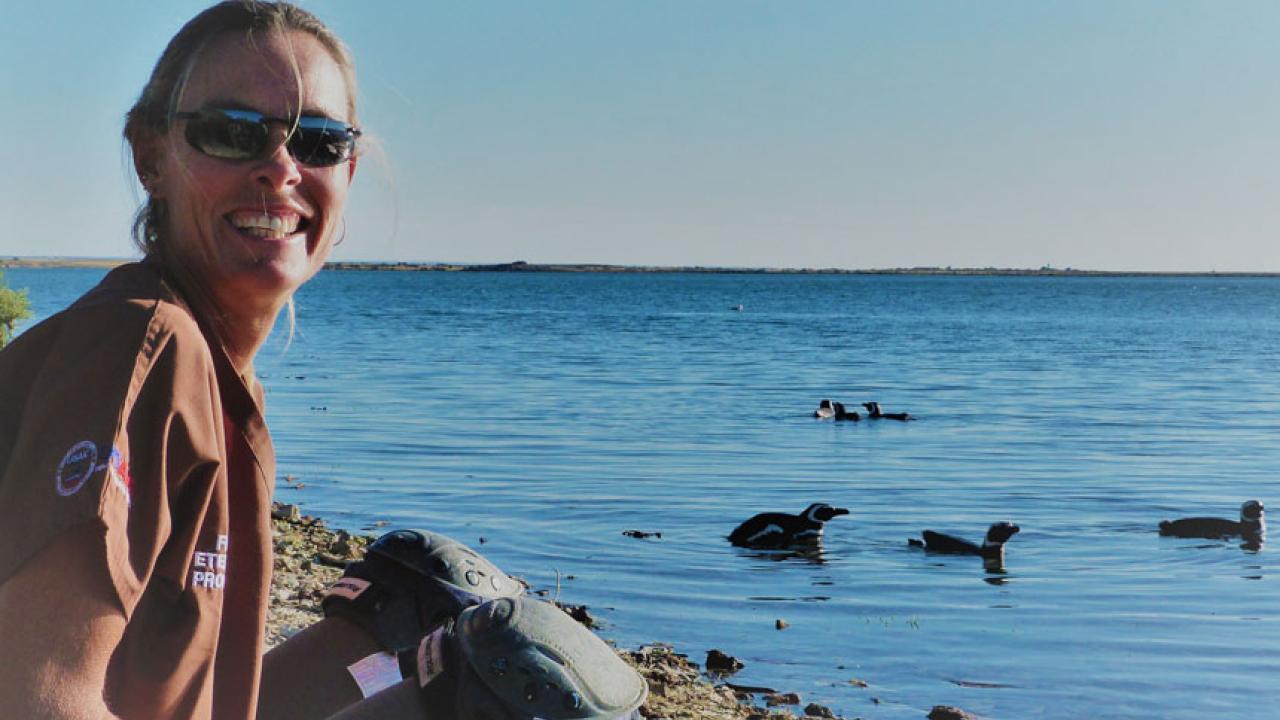
Interview with Dr Marcela Uhart, a veterinarian specialising in wildlife health and an expert in the WOAH global working group and regional coordination group on this topic.
From a very young age, Dr Marcela Uhart knew that her path would be linked to animals. Raised in a rural area in the north of the province of Santa Fe, Argentina, surrounded by nature and wildlife, her vocation for veterinary medicine arose almost instinctively. ‘It’s one of those passions that can’t be explained, something that connects you to animals with every cell in your body,’ she recalls.
Marcela grew up in a rugged environment, between the dry and the humid Chaco, in a region with great biodiversity. She attended a rural school where education combined formal classes with practical activities such as gardening, carpentry, and sewing, without distinction of gender. ‘There were no differences between boys and girls. That had a big impact on my way of seeing the world,’ she explains.
She studied veterinary medicine at the National University of the Centre of the Province of Buenos Aires, and it was during this time that she began to take an interest in wildlife, thanks to the encouragement of a professor who worked with penguins. ‘At that time, there was no formal guidance on wildlife, but I kept repeating that this was what I wanted to do.’
When Marcela was studying, the degree programme was heavily male-dominated: ‘There were 10 women and 90 men. Today, it’s exactly the opposite.’. This change, which she has observed both in Argentina and in other countries, reflects a profound transformation in the veterinary profession and in science in general.
Regarding the challenges of being a woman, Marcela points out that she never experienced them as a direct impediment. ‘Perhaps it has to do with my personality. I never felt that being a woman was a barrier, and I carried on as if it didn’t exist.’ She acknowledges, however, that 30 years ago it was much more difficult to break into certain fields, especially traditional large animal veterinary medicine.
In the field of wildlife, her entry was more natural, partly because it has historically been closely linked to biology, a field with a strong female presence.
For Marcela, the ‘One Health’ approach is not a fad, but an obvious reality. ‘It always seemed obvious to me. The connection between human, animal and environmental health is part of our everyday lives.’ However, she stresses the importance of this approach now being adopted by institutions, universities and international organisations.
‘The challenge is to make the “One Health” approach operational. We still train professionals in silos, when the reality is cross-cutting.’
Throughout her career, Marcela emphasises the importance of mentors, both male and female. ‘Today, I work mainly with teams led by brilliant women, many of whom now hold key positions in governments, universities, NGOs and institutions.’
For new generations of female scientists, her message is clear: science requires effort, resilience and the ability to bounce back. ‘Nothing is easy, many experiments fail, but that is also part of the learning process.’ She also highlights skills that are not always taught at university but are essential: knowing how to listen, working collaboratively, and engaging in dialogue between disciplines and sectors.
Dr Marcela Uhart